2. Mapping
DSGPM-TP for MARTINI2 CG Mapping
Map the molecules to their coarse-grained representations according to the chosen force field rules. AMOFMS can utilize DSGPM-TP to map molecules to MARTINI2 representation (for more information about DSGPM-TP model, please see the original literature). There are two ways to use it:
Shell Command:
TP_MARTINI2 --smiles 'CCCCCCCCCCCCCCCC(=O)OCC(COP(=O)([O-])OCC[N+](C)(C)C)OC(=O)CCCCCCCC=CCCCCCCCC' --num_bead 12 --json_output ./
this process will generate mapping result picture (.png) and mapping result JSON file (.json).

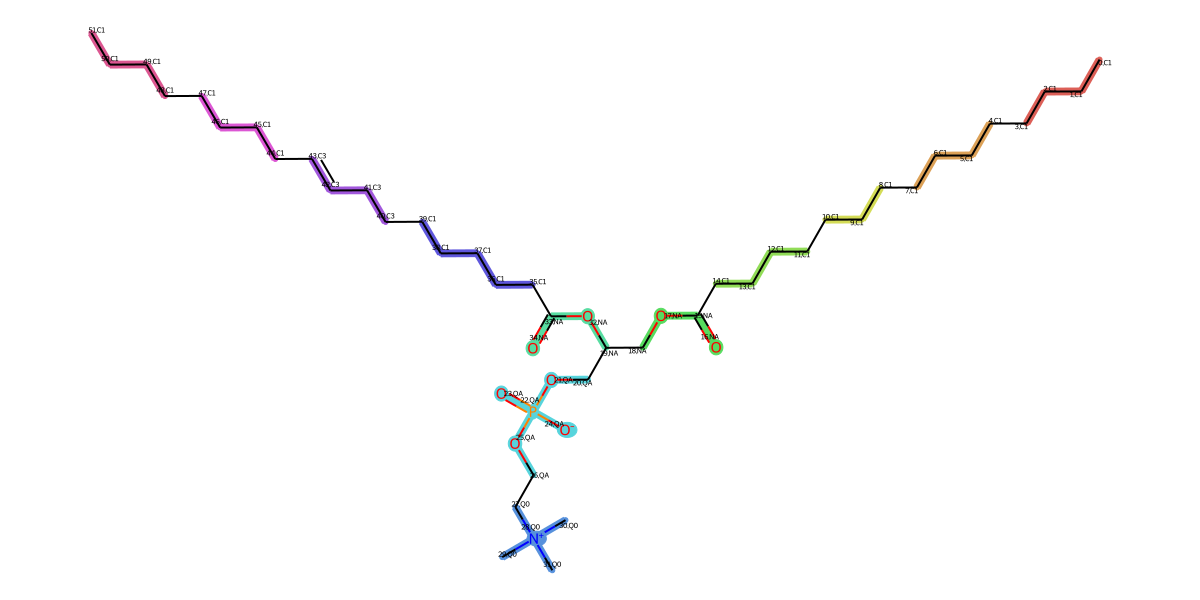
Python Script (Full script is in run_mapping.py.):
from AMOFMS.FGMappingToCG import MappingToCGfromDSGPM_TP, MappingItem
from AMOFMS.CGForceFieldParameters import InitCGForceFieldParameters, generate_system_top
from opt_settings import opt_settings
import os

molecules = [
# molecule 1
    {
        'molecule name': 'POPC',
        'molecular form': 'sml',  # sml or pdb; if use .pdb, please add 'pdb file root'='path/to/your/pdb/file'
        'smiles': 'CCCCCCCCCCCCCCCC(=O)OCC(COP(=O)([O-])OCC[N+](C)(C)C)OC(=O)CCCCCCCC=CCCCCCCCC',
        'number of mapping beads': 12,
        'mapping output folder': './mapping_test/POPC/mapping/POPC',
        'number of atom in molecule': 134,  # including H atom
        'number of molecule in system': 384,
        'residue name': 'POPC',

        # split 134 atom to 12 list corresponding to 12 cg bead(group)
        'aa_group_list': [[131, 132, 133, 128, 129, 130, 125, 126, 127, 121, 122, 123, 124],
                          ...,
                          [78, 79, 80, 81, 82, 83, 84, 85, 86, 87, 88, 89, 90]
                          ]
    },

    # moleucele2
    {'molecule name': 'water', ...}, ...
]

all_cg_molecule_top = []

for molecule in molecules:
    mol_mapping = MappingToCGfromDSGPM_TP(mol_name=molecule['molecule name'],
                                           mol_form=molecule['molecular form'],
                                           smiles=molecule['smiles'],
                                           CG_num_bead=molecule['number of mapping beads'],
                                           output_dir=molecule['mapping output folder'],
                                           CGmodel=opt_settings['coarse-grained model']
                                           )

    FF_parameter_item = InitCGForceFieldParameters(mapping_item=mol_mapping.get_mapping_item(),
                                                   num_mols=molecule['number of molecule in system'],
                                                   setbond=opt_settings['opt bond'],
                                                   setangle=opt_settings['opt angle'],
                                                   setdihedral=opt_settings['opt dihedral'],
                                                   )

    if opt_settings['eq bond from fg']:
        FF_parameter_item.set_bond_parameters(top=opt_settings['fine-grained topology file'],
                                              traj=opt_settings['fine-grained trajectory file'],
                                              num_atom_with_H=molecule['number of atom in molecule'],
                                              num_mol=molecule['number of molecule in system'],
                                              res_name=molecule['residue name'],
                                              group_list=molecule['aa_group_list'])

    if opt_settings['eq angle from fg']:
        ...,
    if opt_settings['eq dihedral from fg']:
        ...,
    cg_molecule_top = FF_parameter_item.generate_cg_ff_parameters_item()
    all_cg_molecule_top.append(cg_molecule_top)

system_topology = generate_system_top(mols=all_cg_molecule_top, num_mols=None)
The opt_settings.py is in here. Use the generate_system_top function to convert all molecules to the system_topology dictionary format. The system_topology can be found in opt_init_para.py.
Note
To initially obtain equilibrium bond lengths from all-atom (AA) molecular dynamics simulations, the corresponding AA trajectory and topology files should be provided.
System Topology (dict)
Then, the system_topology (dict) will be obtained:
system_topology = {'molecules': [
{'mol_name': 'POPC', 'model': 'MARTINI2',
 'types': ['C1', 'C1', 'C1', 'C1', 'NA', 'NA', 'QA', 'Q0', 'C1', 'C3', 'C1', 'C1'],
 'id': [0, 1, 2, 3, 4, 5, 6, 7, 8, 9, 10, 11],
 'charge': [0.0, 0.0, 0.0, 0.0, 0.0, 0.0, -1.0, 1.0, 0.0, 0.0, 0.0, 0.0],
 'mass': [57.1146, 56.1067, 42.08, 56.1067, 58.0357, 57.0278, 123.0234, 73.1372, 70.1334, 54.091, 56.1067, 57.1146],
 'num_mols': 384,
 'fg_groups': [[130, 131, 132, 133, 127, 128, 129, 124, 125, 126, 121, 122, 123],
               ...,
               [66, 67, 68, 69, 70, 71, 72, 73, 74, 75, 76, 77],
               [78, 79, 80, 81, 82, 83, 84, 85, 86, 87, 88, 89, 90]],

 'bond_parameters': {(0, 1): [0.4656, 1250.0],
                      ...,
                     (10, 11): [0.4655, 1250.0]},

 'angle_parameters': {(4, 5, 8): [105.2565, 25.0],
                       ...,
                      (0, 1, 2): [147.8506, 25.0]}},

{'mol_name': 'W', 'model': 'MARTINI2', 'types': ['P4'], 'id': [0], 'charge': [0.0], 'mass': [72], 'num_mols': 3284},

{'mol_name': 'FW', 'model': 'MARTINI2', 'types': ['BP4'], 'id': [0], 'charge': [0.0], 'mass': [72], 'num_mols': 365}],

'lj_cross_terms': {('C1', 'C3'): [0.47, 3.5],
                   ...,
                   ('NA', 'NA'): [0.47, 4.0]},
 'cgmodel': 'MARTINI2'}
The system_topology dictionary contains detailed information about the molecular system used in the simulation. It includes descriptions of molecules, their interactions, and parameters for coarse-grained (CG) models. The following sections describe the structure and components of the system_topology, includeing molecules, lj_cross_terms and cgmodel.
Molecules
Each molecule in the system is represented as a dictionary within the molecules list. The dictionary contains the following keys:
mol_name: Name of the molecule (e.g., ‘POPC’).
model: Coarse-grained model used (e.g., ‘MARTINI2’).
types: List of bead types in the molecule.
id: List of unique IDs for each bead.
charge: List of charges for each bead.
mass: List of masses for each bead.
num_mols: Number of molecules of this type in the system.
fg_groups: Nested lists where each sublist contains the IDs of beads that belong to a specific CG group.
bond_parameters: Dictionary where keys are tuples representing bonded bead pairs, and values are lists containing bond length and force constant.
angle_parameters: Dictionary where keys are tuples representing bonded bead triplets (angles), and values are lists containing angle value and force constant.
{
    'mol_name': 'POPC',
    'model': 'MARTINI2',
    'types': ['C1', 'C1', 'C1', 'C1', 'NA', 'NA', 'QA', 'Q0', 'C1', 'C3', 'C1', 'C1'],
    'id': [0, 1, 2, 3, 4, 5, 6, 7, 8, 9, 10, 11],
    'charge': [0.0, 0.0, 0.0, 0.0, 0.0, 0.0, -1.0, 1.0, 0.0, 0.0, 0.0, 0.0],
    'mass': [57.1146, 56.1067, 42.08, 56.1067, 58.0357, 57.0278, 123.0234, 73.1372, 70.1334, 54.091, 56.1067, 57.1146],
    'num_mols': 384,
    'fg_groups': [
        [130, 131, 132, 133, 127, 128, 129, 124, 125, 126, 121, 122, 123],
        ...,
        [78, 79, 80, 81, 82, 83, 84, 85, 86, 87, 88, 89, 90]
    ],
    'bond_parameters': {
        (0, 1): [0.4656, 1250.0],
        ...,
        (10, 11): [0.4655, 1250.0]
    },
    'angle_parameters': {
        (4, 5, 8): [105.2565, 25.0],
        ...,
        (0, 1, 2): [147.8506, 25.0]
    }
}
Lennard-Jones Terms
The lj_cross_terms dictionary contains parameters for Lennard-Jones interactions between types of beads. Each key is a tuple of bead types, and each value is a list containing the epsilon (depth of the potential well) and sigma (finite distance at which the inter-particle potential is zero) parameters.
{
 #  (bead1, bead2):[sigma(nm), epsilon(kJ/mol)]
    ('C1', 'C3'): [0.47, 3.5],
    ('C1', 'QA'): [0.62, 2.0],
    ...
    ('Q0', 'Q0'): [0.47, 3.5],
    ('NA', 'NA'): [0.47, 4.0]
}
Coarse-Grained Model
The cgmodel key specifies the coarse-grained model (MARTINI2, MARTINI3 and SPICA) used for the system.
'cgmodel': 'MARTINI2'